
Book Writing & Publishing
{The Blog}
Ep 86: Understanding Indie Publishing Options

With the rise of available options for indie authors, authors are more curious than ever about how to navigate so many options without being overwhelmed or disappointed (simply because they didn't know what questions to ask!).
In this episode of Write the Damn Book Already, we cover:
- the various indie publishing options, from self-publishing to hybrid publishing to working with a publishing service provider
- the temptation to work with publishing houses that make lofty promises regarding bestseller status and publicity assistance
- what questions to ask to ensure that your expectations are met should you decide to partner with an indie publishing company for assistance/expert guidance
- the importance of considering the long-term implications of partnering with any publishing house
- what questions authors should ask (and what red flags they should be looking for) when evaluating indie publishing options
RESOURCES MENTIONED
Jenn Hanson-dePaula, Book Marketing
Chip Valutis's bo...
On Writing Your Way INTO Your Book (Part 2)

A revelation hath...revealed itself. (It's 7:17pm, and my brain cells have stopped firing almost entirely.)
Last week, I posted about this revelation: that the process of writing a book is very much like a reverse hourglass (or, say, a stomach, if you're a "Grey's Anatomy" fan).
[If you missed that post on figuring out what your book is about, you can read all about it here.]
It stinks that most writers don't realize where the starting place actually is (and that it's often important to spend more time there than one thinks).
I didn't understand this myself for many years!
And the bottleneck this creates causes them to think they're doing something wrong when, in fact, they're just like everyone else writing a book!
But today, let's talk about Part 2: What Do I Want to Say?
This is the BIG part of the reverse hourglass, or stomach, and it's where the bulk of the work/writing takes place.
(Who's dying to hire me to illustrate their children's book. Anyone? Hello?).

You k...
On Writing Your Way INTO Your Book (Part 1)

I often say, "We write (or talk) our way INTO what what we want to say."
It's somewhat similar to talking yourself into doing something—using words to explore how you feel or why something seems scary in order to get to the root of the what and the why.
During a recent Book Writers Collective call, I realized, by talking my way into it, that when writing/publishing a book, we experience a "reverse hourglass" effect of sorts.
For fun, I also envision it as a stomach (ironically, the body part most heavily churning with anxiety and trepidation during this adventure).
Without knowing that the first step (of 3) is one of two bottlenecks, many of us get stuck there. Which is both unfortunate and unnecessary!
Allow me to explain via a delightfully friendly graphic.

As you can see, the first step is one of two bottlenecks—points where you're most likely to become quit.
And that step is...
...figuring out what the hell the book is about!
Is it about a specific time in your lif...
Ep 85: Book Marketing Tips from Publicist and Industry Expert Kathleen Schmidt

As the Founder and CEO of Kathleen Schmidt Public Relations, Kathleen is a well- respected voice in book publishing with in-depth experience in all aspects of the industry, including as a publicist, literary agent, acquisitions editor, and ghostwriter.
Her career encompasses 30 years of creating and directing impactful and strategic global media, marketing, and branding campaigns for politicians, A-List celebrities, athletes, and high-profile personalities.
To date, she has worked on 50 New York Times bestsellers, and her clients have continuously appeared in top-tier national print, broadcast, and radio outlets such as The Today Show, Good Morning America, Vogue, Elle, Financial Times, Vanity Fair, GQ, and Sirius XM.
I was thrilled to chat with her about her perspective on book publishing as well as the rise in indie author opportunities.
EPISODE HIGHLIGHTS
- Navigating the current negativity/collective rut in book publishing
- The truth about bookstore distribution today (inclu ...
Ep 84: Launching the Sophomore Novel with Donna Norman-Carbone

Donna Norman-Carbone's second novel, Of Lies and Honey, just launched (April 24, 2024, Red Adept Publishing), and it was wonderful to have her on as a repeat guest.
Her first novel, All That Is Sacred, came out less than a year ago (June 2023, Red Adept Publishing), and chatting about the differences between book 1 and book 2 proved as fun and insightful as I knew it would!
EPISODE HIGHLIGHTS
- The biggest differences between the first launch and the second (including the task she full-on forgot to do when launching the first book!)
- How Donna navigates looking at sales numbers and reviews
- Using NetGalley for reviews: the benefit of being with a smaller publisher versus a Big 5 publisher
- The admission that made me question whether Donna and I could be friends (yes, that’s clickbait.)
- The challenge of writing back cover copy/book jacket summary
- Donna's strategy for ensuring she doesn’t get “stuck” while writing a book
ABOUT DONNA
Donna Norman-Carbone's debut novel, All Th...
Ep 83: Self-Publishing Cookbooks and Children's Books

The time has come! We're finally able to move on from the days of traditional offset printing to print-on-demand options when it comes to children's books and cookbooks. Whether you're contemplating watercolor illustrations for a children's book or publishing a mouthwatering cookbook, this episode is for you!
EPISODE HIGHLIGHTS
- Managing the balance between print quality, profitability, and the different book distribution methods at your disposal.
- The nitty-gritty of offset printing vs. the economics of self-publishing
- The pros and cons of overseas printing
- The real costs of self-distribution
- Demystifying the printing process to ensure your images pop off the page.
RESOURCES MENTIONED
Publish A Profitable Book discount: For a limited time, we're celebrating the updates to the Publish A Profitable Book course with 15% off! Use code PUBLISH15 at checkout (applies to pay-in-full AND payment plan options!).
>> Which publishing approach is best for you? Click here t...
EP 82: Memoir On Submission with Diana Naranjo

The story is always unfolding...
In this episode of Write the Damn Book Already, I spoke with Diana Naranjo about her memoir (which is currently on submission). She recounts a pivotal moment where a professional connection with author Abraham Verghese (Cutting for Stone, The Covenant of Water) led to her first agent connection.
EPISODE HIGHLIGHTS
- How Diana learned to write after completing her first draft
- The nuanced difference between memoir and creative non-fiction
- Her strategies for finding agents and the value of learning from the author community's experiences.
- The challenge of identifying as "a writer"
CONNECT WITH DIANA
Instagram: @dnaranjo
WHAT DIANA'S READING NOW
Tell Me Everything: The Story of a Private Investigation by Erika Krouse
RESOURCES MENTIONED
In a Not So Perfect World by Neely Tubati Alexander
The Covenant of Water and Cutting for Stone by Abraham Verghese
Everyone But Myself by Julie Chavez
Tough Titties by Laura Belgray
Ep 81: Permission to Do What You Want as an Author

Key Takeaways:
-
It's important to give yourself permission to try different approaches and strategies when writing and publishing a book.
-
Don't feel pressured to follow the advice of others if it doesn't align with your goals or preferences.
-
Consistency and courage are key to finding success in your writing journey.
Introduction
In this episode of the Write the Damn Book Already podcast, we discuss the importance of giving yourself permission to do what feels right for your book, regardless of the advice and opinions of others. Let's dive in and explore the power of embracing your own path.
Embracing Your Unique Approach
In the world of book writing and publishing, there is no shortage of advice and opinions on the "right" way to do things. From running ads to choosing the perfect marketing strategy, it can be overwhelming to navigate through the sea of recommendations. However, it's crucial to remember that what works for one person may not work for anot...
Ep 80: How to Avoid Copyright Infringement (and Other Listener Questions)

In this solo episode of Write the Damn Book Already, I respond to listener's questions, including:
- How do I make sure I'm not infringing on someone else's copyright by referencing their advice, book, or insights in my book?
- Why is publishing so complicated?
- Why do I become an insecure mess whenever I sit down to write?
RESOURCES MENTIONED
Cory Goodrich's book, Folksong: A Ballad of Death, Discovery, and DNA
Write the Damn Book Already is a weekly podcast featuring interviews with authors as well as updates and insights on writing craft and the publishing industry.
Available wherever podcasts are available:
Apple Podcasts
Spotify
YouTube
Let's Connect!
Instagram
Website
Email the show: elizabeth [at] elizabethlyons [dot] com
The podcast is a proud affiliate partner of Bookshop, working to support local, independent bookstores.
To see all the ways we can work together to get your book written and published, visit publishaprofitablebook.com/work-with-elizabeth
Ep 79: Querying Literary Agents with Lauren Kay

Lauren Kay's young adult debut novel, We Ship It, was a dream come true, but it wasn't easy to get there. Now, she helps other writers achieve the same joy, minus the roadblocks. Having secured eight agent offers in a month, she works with authors dreaming about a traditional publishing deal to help them write irresistible query letters.
INTERVIEW HIGHLIGHTS
- The 7-year path to her first novel, for which she received a 6-figure advance (best quote: "Lightning speed in this industry is 7 years.")
- The importance of transparency in the book industry when it comes to timelines, sales figures, and overall expectations
- The idea of an author “deserving” their lead author status (I hadn't heard this before, and loved the discussion around it!)
- How changing our expectations as authors can lead to far better results
- The “before” and “after” of publishing
- Top mistakes to avoid when writing query letters + how to navigate the world of querying without becoming (too) disappointed ...
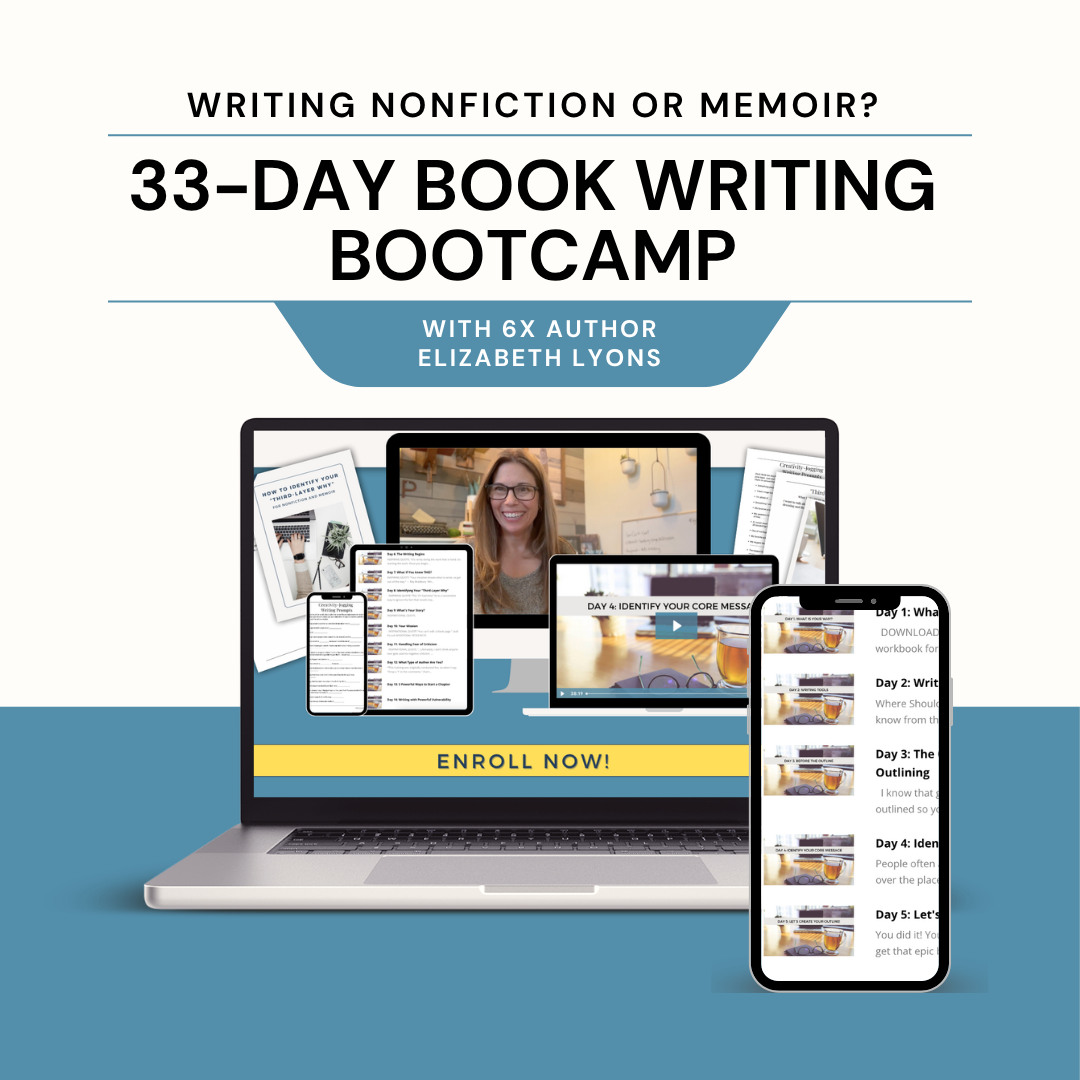
Ready to Write the Damn Book Already?
Get the first draft of your nonfiction or memoir written in 33 days!
...even if you don't have a cabin in the wilderness, 4 uninterrupted hours a day to write, or confidence that you're a "real" writer.

Amazon Ads for Indie Authors!
Learn how to run Amazon ads that actually work—even if you’ve never touched an ad platform in your life.

Want all my best author email templates?
From communicating with your launch team to building long-term relationships with readers, these templates take all the guesswork out of writing emails that turn email subscribers into loyal readers!

Need Coaching, Accountability & Community?
The Book Writers Collective provides the coaching, support, and writers' community you need to bring your book to life!

SELF-PUBLISHING STARTER KIT
Discover the exact steps to focus on (and mistakes to avoid) so you can self-publish an incredible book that's indistinguishable in quality from a New York Times bestseller.
