
Ep 191: How to Write a Book When Your Day Job Uses the Same Brain (with E.L. Shen)
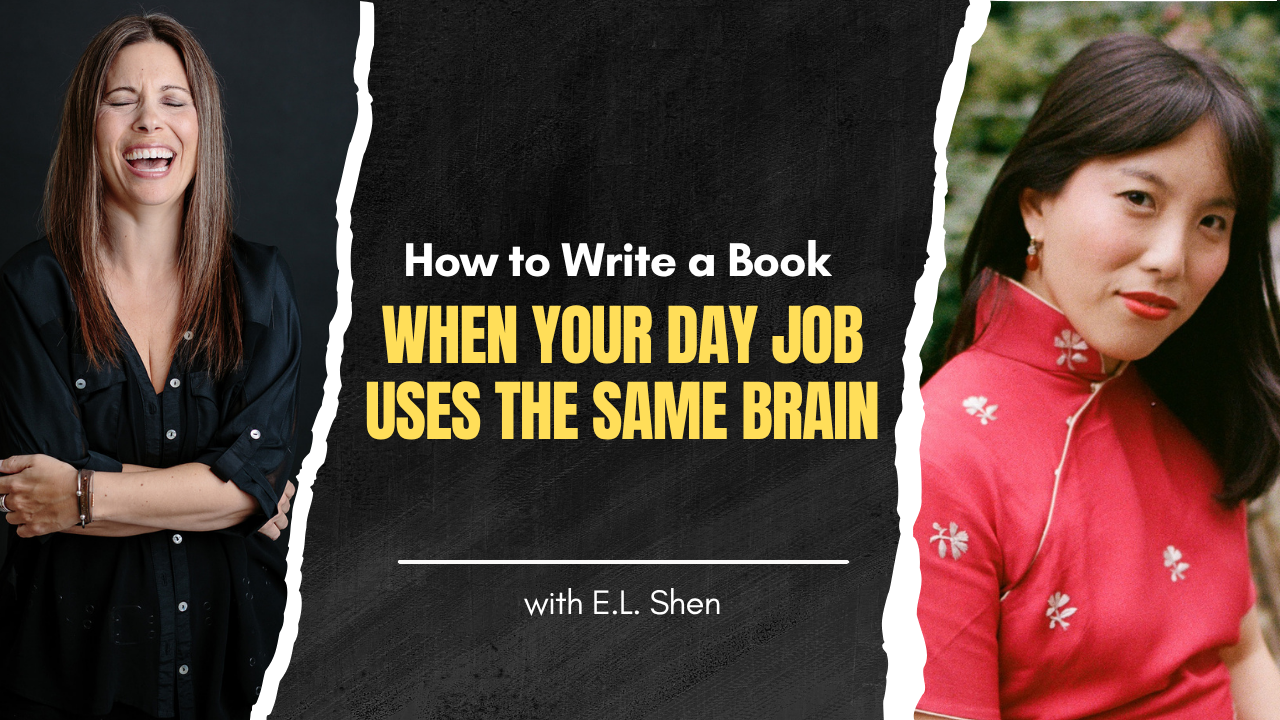
E.L. Shen (who goes by Elizabeth) has published four books. She is also an executive editor at Penguin Young Readers, which means she spends her working hours doing a version of the thing she loves doing in her free time.
Her newest novel, Foreigners, came out September 22, 2026 from Quill Tree Books. Moving across three timelines, it’s her first historical novel and it started with a series of interviews with her 93-year-old grandmother.
I was excited to talk to her for several reasons, not the least of which is that I'm in the same strange position right now. I edit other people’s books for a living, and I’m finishing my first novel, which means I keep catching myself doing to my own manuscript exactly what I tell clients not to do to theirs!
Why She Only Writes on Weekends
Most of her day goes to her editorial job, and that job runs on creative energy. By evening, she doesn’t want to look at another book. So she writes almost exclusively on weekends.
So much writing advice assumes one's day job is unrelated to writing. If you’re an accountant, your creative mind is relatively fresh at six o’clock (while the rest of your body is screaming for bedtime). But if you spend eight hours reading manuscripts, teaching, editing, or writing copy, you’re drawing from the same well twice.
Mapping the Week Before You Write
A couple of hours on a weekend doesn’t sound like much, and she's clear about that. So she plans around it by mapping out what time she’s going to use and when, factoring in whatever else is happening that week, and asking how much bandwidth she honestly has. She then sets expectations accordingly.
It's important to Elizabeth to be on time and thoughtful as an author. She also wants to be realistic about what she can and cannot do. If writing were her full-time job, she says, she’d be much faster, but that’s simply not the shape of her life.
I tell myself the same thing, but I’m not sure it’s true. I have never had the chance to write full time, so I don’t actually know whether I’d be faster. Honestly, I suspect I’d be slower, because I’d have more hours in which to overthink!
When You Can’t Turn Off Your Editor Brain
Elizabeth self-edits constantly while drafting. Before starting a new chapter, she goes back and rereads the previous one. It’s just how she works now. Her conclusion is that it makes her a cleaner writer and it makes the whole thing take longer. She’s decided to simply expect that from herself and accept it as her unique process instead of fighting it.
What she absolutely understands is that, even as a full-time editor, she cannot evaluate her own work accurately. She describes having tunnel vision on her own manuscripts; something might be good or bad, but she genuinely cannot tell because she’s standing too close.
She also notices the same pattern in the authors she edits. They’ll ask her a question during first-round edits about some small detail, and her internal response is that nobody cares about that yet; right now they’re just trying to figure out the plot. Then she catches herself doing it in her own drafts (which is entirely relatable).
Editors as Therapists
Her editor, Jen, will say, "Here’s the end result we’re after, here’s the behavior we want from this character, here are some ideas. Now, what does your brain want to do?" She doesn't say, "Do this specific thing." She helps identify a destination and several possible routes for getting there, leaving room for the author to make the ultimate decision.
She’s received notes she didn’t want to take, but notes that the value wasn’t in the suggestion itself. A note she rejects still often sparks an idea she wouldn’t have had otherwise.
We talked about editors playing a role similar to a great therapist: A good therapist helps you uncover what you actually think without projecting their own experience onto you. A good editor does the same thing with your book. They offer the direction, then let go of whether you take it.
Why Ego Has to Bet Let Go (on Both Sides)
An editor with an ego attached to their suggestions isn’t doing the job; neither is an author who can’t hear any of the suggestions.
Editing is of course subjective past a certain point, which is the uncomfortable truth underneath all of this. Ten good editors will give you ten slightly different sets of notes, most of them defensible. For those of us who want one correct answer, this is a terrible profession!
Elizabeth sees it up close, working with different editors on her own books and being an editor at a third house. She gets to experience multiple editorial styles at once, all aiming for the same goal of helping the author complete their vision but getting there differently.
Low Expectations and Low Overhead
We talk about a concept I heard a week prior from Min Jin Lee, which is that writing full time requires low expectations and low overhead. The overhead part is financial. Keep your life small enough that the math works.
The expectations part connects to the ego conversation. You can want big things, but you can’t expect them, because publishing is not a formula that can be solved. And let's be honest, if it were, most of us would be bored to pieces.
Most authors I talk to have a second source of income, or had one, or will again have one. It’s rarely a straight line from book to living.
Monetizing Your Identity for Profit
When you publish a book, you’re monetizing your identity for profit. Which means if the book doesn’t do well, by whatever definition of well you’ve attached to it, the thing that failed feels like...you.
Roughly a third of the authors she edits are first-timers, and she spends significant time managing their expectations. So do I, and I always worry I come across as negative when I’m trying to be realistic. Hearing that she has the same worry was a relief.
Her advantage is that she’s living it from both chairs. She can tell an author she knows exactly how vulnerable this is, because her own book is out there doing whatever it’s going to do.
What Three Timelines Actually Required
Foreigners has three points of view across three eras, which sounds to me like a structural nightmare. Her approach to this was less mystical than I expected.
She’s a committed outliner. Chapter by chapter, with the full acknowledgment that she probably won’t stick to it. The outline isn’t a contract; it’s a place to start from when she sits back down. By the end of the first draft, she’s not referring to it at all, but it's helped provide the foundation. She’s also a chronological writer, which is why rereading the previous chapter matters so much to her process.
The research for Foreigners took about six months, and she’s not a history person. The whole thing grew out of interviews with her grandmother, who is 93, about leaving Taiwan and landing at a rural Mississippi college in the 1950s, not long after the Chinese Exclusion Act ended. One of the three narrators is a real ancestor of hers whose belongings are in the Met. She even had the opportunity to sit with the curator of his collection and hand him a copy of the book.
Two things surprised Elizabeth about the writing of this book. The present-day character was harder to write than the historical one, because that character is emotionally shut down and E.L. Shen is a heart-on-her-sleeve person. And her first chapter barely changed from draft one to the finished book, which is the opposite of what I see in almost every manuscript I work on. Her explanation is that the emotion in it came from something real, so it arrived mostly intact.
ABOUT E.L. SHEN
Website: elshenwrites.com
Instagram: @elshenwrites
Want to Stay in the Know?
Sign up to receive the latest book industry news and updates!
Ready to Write the Damn Book Already?
Get the first draft of your nonfiction or memoir written in 33 days!
...even if you don't have a cabin in the wilderness, 4 uninterrupted hours a day to write, or confidence that you're a "real" writer.

Amazon Ads for Indie Authors!
Learn how to run Amazon ads that actually work—even if you’ve never touched an ad platform in your life.

Want all my best author email templates?
From communicating with your launch team to building long-term relationships with readers, these templates take all the guesswork out of writing emails that turn email subscribers into loyal readers!

Need Coaching, Accountability & Community?
The Book Writers Collective provides the coaching, support, and writers' community you need to bring your book to life!

SELF-PUBLISHING STARTER KIT
Discover the exact steps to focus on (and mistakes to avoid) so you can self-publish an incredible book that's indistinguishable in quality from a New York Times bestseller.
