
Ep 183: The Book Editing Process, Explained (with Allison Buehner)
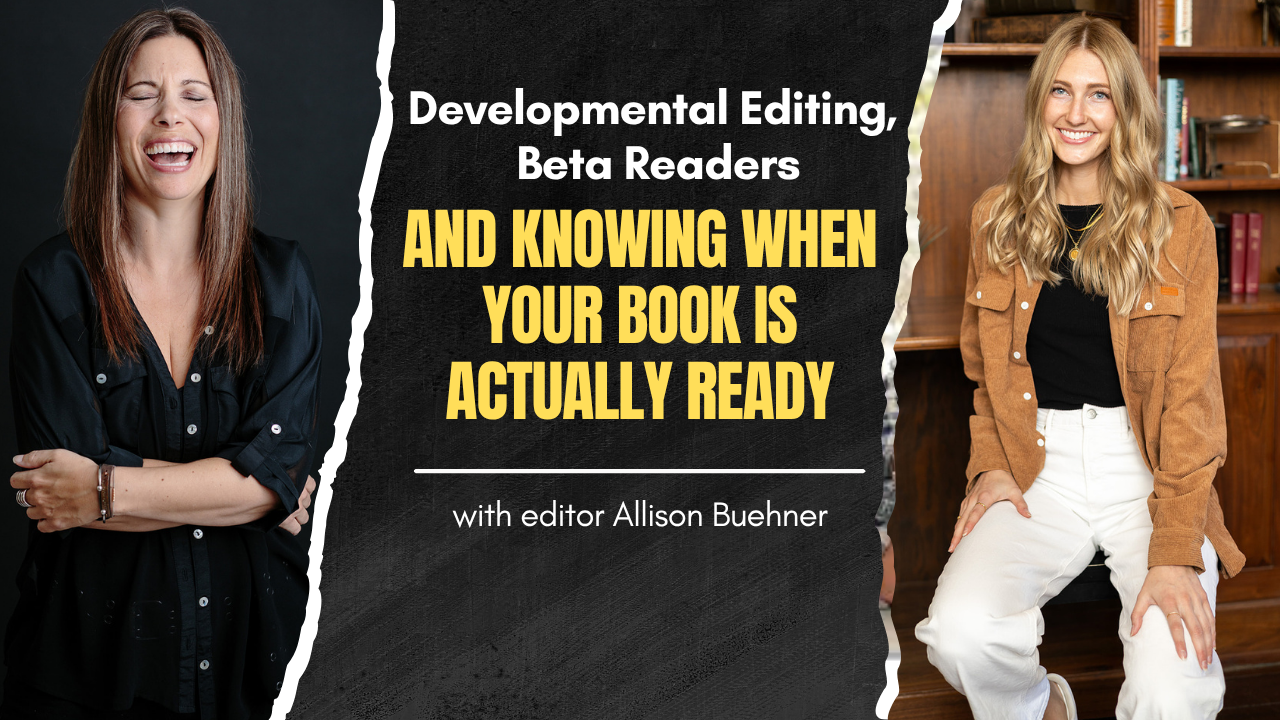
Most first-time authors don't hire the wrong editor. They hire the right editor at the wrong time, which costs the same amount of money and gets them a fraction of the value.
I've been editing nonfiction and memoir for two decades, and I hear a version of this every few weeks. Someone finishes a draft on a Tuesday and wants to book a proofreader for the following month.
Fiction editor Allison Buehner of Golden Editorial gets the same email, constantly, from self-publishing authors who assume proofreading is all editing is. We talked about it at length on this recent episode of Write the Damn Book Already, and I want to lay the whole thing out here, because nobody hands you a map of this when you decide to publish a book.
The four types of book editing, in the order they happen
Here's the short version, and then we'll go deeper on each one.
Developmental editing looks at the book as a whole. Structure, pacing, argument, character, whether the thing delivers what it promises. This is the big-picture edit, and it comes first.
Line editing works at the level of the sentence and paragraph. Rhythm, clarity, word choice, whether your voice is actually landing on the page.
Copy editing handles correctness and consistency. Grammar, punctuation, style adherence, and catching the fact that your protagonist's sister changed names in chapter nine.
Proofreading is the final sweep, usually on the formatted file. It catches typos, spacing problems, and the stray comma that survived everything else.
Line and copy editing overlap enough that plenty of editors, myself included, bundle them. The order of the larger stages, though, is not flexible. Each one assumes the one before it is finished.
Why the order matters more than anything else on this page
If you proofread a book before you've fixed its structure, you're paying a professional to perfect sentences that are about to be deleted. Developmental work routinely means cutting chapters, moving your opening, collapsing two characters into one, or reordering the entire middle of a nonfiction book once you finally understand what it's about.
Every polished sentence in the removed material was money spent on...nothing. The reverse is also true, and it's the part authors underestimate. A messy manuscript makes developmental feedback worse. As Allison put it, even spelling and grammar can muddy the intention of an entire book, and more granularly, of a single sentence. If an editor can't tell what you were trying to say, she can't tell you whether it's working.
The sequence isn't a scheme to sell you four services; it's the only order in which each service can actually do its job.
Before any of it: self-editing
There's a stage before you hire anyone, and it's the one most first-time authors skip. Self-editing means taking your own pass, or several, through the manuscript. Allison can tell immediately which authors did this and which didn't. So can I.
This is also the stage where a lot of first-time authors discover the real shape of their book. The first chapter you wrote is almost never the first chapter that belongs in the finished book. With nonfiction especially, once you understand the whole argument, that opening has to be rebuilt from scratch. Which is why most authors hone chapter one last.
The reader feedback stage, and who's supposed to be reading
Somewhere between self-editing and professional editing, other human beings need to read your book. The terminology here is a mess, so let's define it.
A critique partner is another writer, often one with whom you exchange work. You swap chapters and give each other feedback, and a good one knows how to hold back a note you're not ready for yet.
An alpha reader takes your full first draft, before self-editing, and answers one question: Does this work? My own definition is slightly looser than Allison's. For me, an alpha reader is the person I hand pages to knowing they'll say keep going. I'm aware it isn't good yet (nothing is good in first draft). What I need is confirmation I'm pointed the right direction.
A beta reader comes later and reads with a reader's mindset. They are not editing. They're simply experiencing the book the way your eventual audience will, then telling you where they got lost, bored, or unconvinced.
Allison's criteria for choosing beta readers are the tightest I've heard. They have to read your genre, no exceptions. They have to be willing to be blunt, which is precisely why family and close friends usually don't work. They love you, so they'll tell you it's perfect while privately hoping you never publish it. And they have to be someone you trust, because handing an unfinished book to anyone is genuinely frightening.
One tactical piece worth stealing: don't hand anyone the whole manuscript on day one. Give them ten pages and see whether their feedback is useful to you. Allison compares it to an interview, and she's right. You're evaluating them as much as they're reading you.
Have a list of specific questions for beta readers, too. Otherwise, you'll get a free-for-all. Allison tells her beta readers explicitly not to comment on grammar or word choice, because that's not the stage the book is in.
Writers groups are the most reliable place to find these people, and they turn writing from a solitary-feeling activity into something that actually resembles a community.
What a developmental edit actually looks like
This surprises people, so brace yourself. A developmental edit often arrives as a ten- or twelve-page written summary of what isn't working. Your manuscript itself comes back with very little markup on it. It looks, at first glance, like you paid a substantial amount of money for a document assigning you homework.
Then, compare that to a line and copy edit, which comes back looking like the manuscript is hemorrhaging. I change my track changes color to blue specifically so it doesn't resemble a crime scene, and authors still open the file and gasp.
The heavy-looking edit feels like more value. The lighter-looking one is doing the structural work that determines whether the book is good.
Will an editor fix my book for me?
No, and a good one will say so directly. Rewriting your book is co-authoring, and it's a different job with different ethics and a different price tag. What an editor gives you is the problem, named clearly, along with some possible directions. Allison adds a caveat I love and use as well: If her suggested fix doesn't feel right to you, the problem is still a problem. Her (or my) solution just wasn't your solution! Go back to the problem and solve it your way.
Editing is an investment in your learning as an author. Every edit you pay for is money spent on the books you haven't written yet. I've watched this play out across multiple books with the same author. Something they didn't know how to do in book one has become part of who they are as a writer by book two. Nobody came out of the womb holding a pencil. This is how it gets learned.
How do I know when I'm ready to hire an editor?
Allison's answer was immediate, and I concur: You're ready when you've taken the book as far as your own ability can take it. Maybe you can tell something isn't working, but you can't name it. Maybe you think it's perfect. Either one is fine. Once you've done everything you personally know how to do, a professional can help with the nuanced things you don't yet know how to spot.
The mindset to abandon is the one where an editor is cleanup crew. Your money is best spent on expertise you don't have, not on tidying work you could have tidied yourself.
A note on breaking the rules
Since we're talking about editing conventions, this needs to be said. Allison genuinely loves it when authors want to do something different, and she has no interest in being the editor who insists there's one correct way to write a book. Neither do I.
The distinction she draws is between an author who understands a convention and breaks it deliberately, and an author who never learned it and decided that was fine. She can almost always tell which is which. There's also a ceiling. Her working guideline is that a book can support around three broken rules. Break ten and your reader has nothing familiar left to hold onto.
Where to start if this all feels like a lot
Pick the stage you're actually in and do only that. If you're drafting, keep drafting. If you've finished a draft, self-edit before you do anything else. If you've self-edited, find readers who aren't related to you and give them ten pages. If readers have weighed in and you've done what you can with their notes, then it's time to talk to a developmental editor.
You do not need to solve the whole publishing process today. You need to know what comes next, which you now do.
CONNECT WITH ALLISON BUEHNER
Website: thegoldeneditorial.com
Instagram: @thegoldeneditorial
YouTube: youtube.com/@GoldenEditorial
Want to Stay in the Know?
Sign up to receive the latest book industry news and updates!
Ready to Write the Damn Book Already?
Get the first draft of your nonfiction or memoir written in 33 days!
...even if you don't have a cabin in the wilderness, 4 uninterrupted hours a day to write, or confidence that you're a "real" writer.

Amazon Ads for Indie Authors!
Learn how to run Amazon ads that actually work—even if you’ve never touched an ad platform in your life.

Want all my best author email templates?
From communicating with your launch team to building long-term relationships with readers, these templates take all the guesswork out of writing emails that turn email subscribers into loyal readers!

Need Coaching, Accountability & Community?
The Book Writers Collective provides the coaching, support, and writers' community you need to bring your book to life!

SELF-PUBLISHING STARTER KIT
Discover the exact steps to focus on (and mistakes to avoid) so you can self-publish an incredible book that's indistinguishable in quality from a New York Times bestseller.
