
Ep 192: How Do Authors Write So Many Books? Debra Webb Has Published 185
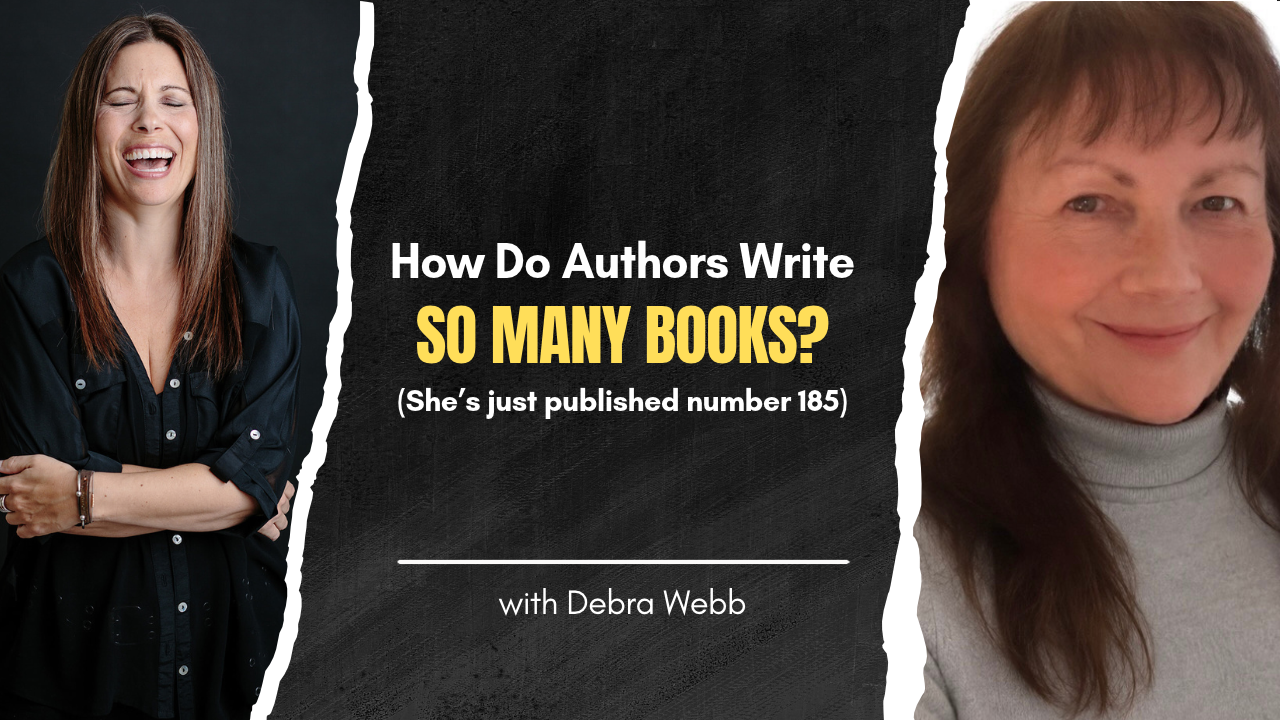
I did the math out loud while we were recording; if I wrote two books a year for the rest of my life, I still wouldn’t catch Debra Webb.
She has published 185 books. The newest one, The Woman I’ve Become, came out November 1, 2026 from Thomas & Mercer.
She also didn’t sell her first book until she was 40.
So I asked her the obvious question: "How have you written so many books?" The answer turned out to be less about speed than I expected.
She Sold Her First Book at 40
She’d written five manuscripts by then. The fifth one was the one that sold.
Her first hundred or so books were Harlequin Intrigues, which run around 60,000 to 65,000 words, shorter than the novels she writes now. The plots were simpler, built around two main characters she could drop into trouble, and she loved coming up with the trouble. In her words, she’s never thought of a murder she didn’t want to dive into.
She’d been making up stories since childhood, pecking them out on a typewriter her mother found at a yard sale. She got serious around age 13, then got serious about boys at 15, and everything paused for marriage, a family, and years of moving around for her husband’s military career. She came back to it in the mid-1990s when a friend asked why she never wrote down any of the stories she was always telling.
The Manuscript With a Dog Narrator
That first book took nine months. She describes it as having a good plot and being otherwise terrible.
She gave a dog a point of view. Not as a stylistic swing, but because she didn’t know what point of view even was. She’d never taken a class or been to a writers’ group.
She was also enthusiastic to a degree she now finds funny. Her mother watched a country music talk show and suggested she call them for advice. She did. The assistant told her to send the manuscript to Mel Berger at William Morris, so she mailed it off, mentioning in the letter that the assistant had told her to.
He wrote back to say he had neither the time nor the inclination to read it.
She kept writing anyway, one story after another, because she had no intention of being stopped.
How She Researched Her Way to a Publisher
This is where her business background showed up, and it’s the most replicable piece of our entire conversation.
Rather than submitting blindly, she did some research to determine which publisher bought the most books each year. A friend who read voraciously told her it was Harlequin. So that’s where she sent her work.
The one that sold went in as three chapters and a synopsis, a format she still dislikes because she can’t tell you how a story ends before she’s written it. Regardless, she made one up and sent it.
At that point, Harlequin hadn’t acquired a manuscript from a new author in two years. She submitted in January or February. In July they asked for the rest of the book, which she then had to hurry up and finish. The yes came by phone on a Friday in November, and she cried through enough of the call that her editor told her to call back Monday.
Why Stories Arrive in Chunks
Plenty of writers say that a book takes a long time to write because it comes to them in pieces. That isn’t Debra's experience. A story arrives in large sections, closer to watching a movie play out in her head.
Once she’s worked out who the characters are and what they’re doing, she starts writing. She writes every day when she can, not because of a word count goal but to stay inside the characters’ heads.
She also uses Zillow to find where her characters live, which I also do (and thought I might be alone in this activity). If she can get to the location in person, she’ll drive through the neighborhood looking at houses, fully aware that she looks like someone casing the place.
What She Can Only See After Setting It Down
This part of Debra's process explains how she's reached 185 books.
She doesn’t truly know her characters until she reaches the end of the first draft. Until then, she knows their names and jobs and where they live, but not what they’d do in any given situation. So the first draft is partly a discovery exercise; the real work happens on the pass after it.
She sets the finished draft aside for a while, and when she comes back she can see all the "dumb" things (her words) she did and what needs to change. Then she goes back through and layers in everything the story actually needs.
That’s the structure underneath 185 books: a fast first pass that she doesn’t expect to be good, followed by a slower one where the book gets made.
The Accident That Sent Her to Self-Publishing
Around book 80, she started going darker, into the more complicated psychological suspense she writes now.
Then, she was in an accident and lost the use of her right arm, which is her writing hand. It took three years just to learn to sign her name again. She was the sole breadwinner and couldn’t work at anything close to her old speed.
Friends who were already self-publishing pointed out that she had unsold manuscripts sitting in a drawer. One of them was the first book in a series titled Faces of Evil, built on a real scale of evil developed to help judges weigh the motive behind a killing. She’d never been able to get that first book right. While recovering, she finally figured out what it needed to be.
She published it herself. Six weeks later, she put up the second one. It took off, and that series is what put her on the map. Hachette picked up the rest of it.
Why She Hands Over the Cover and the Title
Having both traditionally and self published, she’s clear about the trade-offs of each paradigm.
Self-publishing gave her final say on covers and titles, which she enjoyed. She also says there is genuinely something to be said for a publisher handling all of it, which is why she’s happy now, working with an Amazon imprint.
Sometimes the final title isn’t the one she’d have picked, or a cover looks different from what she pictured. But she reminds herself that she’s a writer and not a marketer, and she doesn’t know what appeals most to readers on a cover. What she cares about is what’s between the covers.
It's a trade a lot of authors agonize over—giving up a measure of control in exchange for a partner who handles the parts you don’t want to learn.
185 Books In, She Still Needs an Editor
This is what I most want new authors to take from the conversation.
At 185 books, Debra Webb still relies on a developmental editor, and she describes the person who does that work for her as someone who can point out a problem and have her fix it without changing her voice or style.
Sometimes you know in your brain what’s happening on the page, but it doesn’t make it from there to the page. When you reread it, your mind supplies what you meant, so you can’t see that it isn’t actually written.
This is why editors are so important. She compared it to painting a room. You’re putting the color on, your eyes adjust, the whole wall looks covered. Then you come back the next day and see every spot you missed.
Experience doesn’t solve that. Only another set of eyes does.
The Woman I’ve Become is out now from Thomas & Mercer.
ABOUT DEBRA WEBB
Website: debrawebb.com
Instagram: @debraewebb
Want to Stay in the Know?
Sign up to receive the latest book industry news and updates!
Ready to Write the Damn Book Already?
Get the first draft of your nonfiction or memoir written in 33 days!
...even if you don't have a cabin in the wilderness, 4 uninterrupted hours a day to write, or confidence that you're a "real" writer.

Amazon Ads for Indie Authors!
Learn how to run Amazon ads that actually work—even if you’ve never touched an ad platform in your life.

Want all my best author email templates?
From communicating with your launch team to building long-term relationships with readers, these templates take all the guesswork out of writing emails that turn email subscribers into loyal readers!

Need Coaching, Accountability & Community?
The Book Writers Collective provides the coaching, support, and writers' community you need to bring your book to life!

SELF-PUBLISHING STARTER KIT
Discover the exact steps to focus on (and mistakes to avoid) so you can self-publish an incredible book that's indistinguishable in quality from a New York Times bestseller.
