
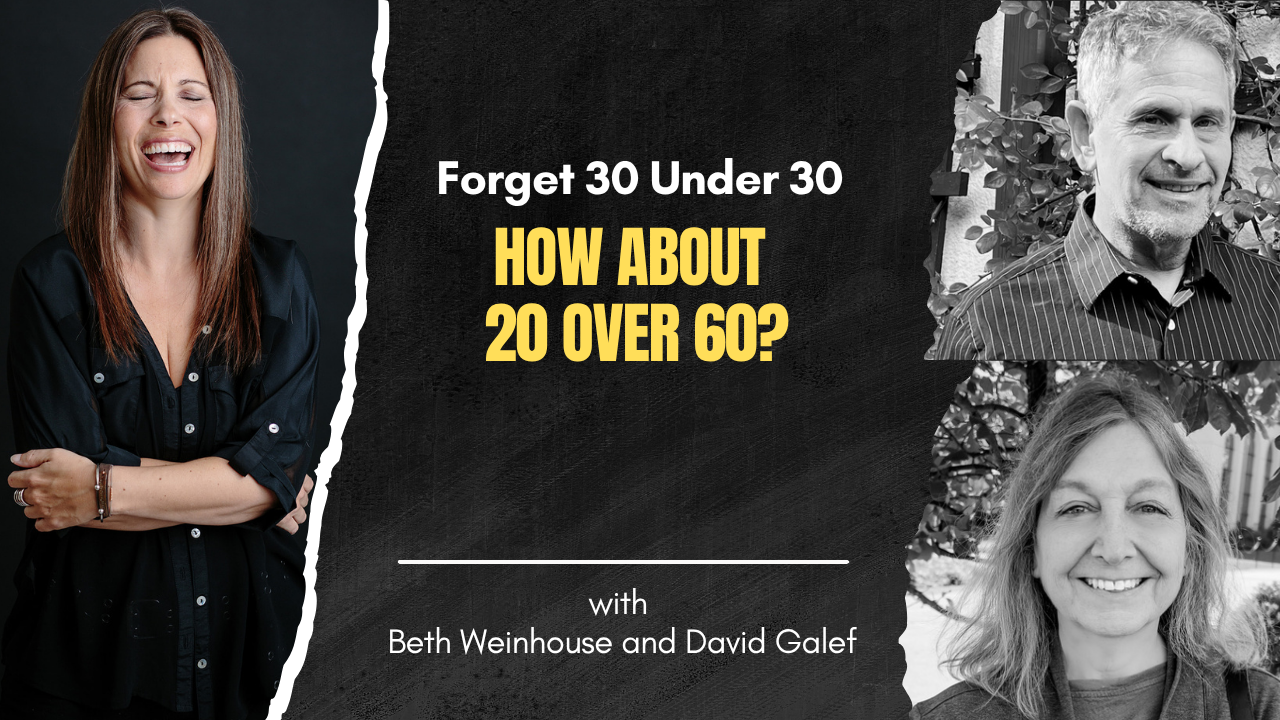
Ep 188: Forget 30 Under 30; How About 20 Over 60? (with Beth Weinhouse and David Galef)
I'm in my fifties, and every 30 Under 30 list does the same thing to me. I'm genuinely happy for the people on it. I also read it and feel like I missed a boat and train I didn't even know were leaving.
David Galef and Beth Weinhouse had that exact reaction in their late thirties when they came across an anthology titled 30 Under 30. Rather than stew about it, they put together 20 Over 40. When the call for submissions went out, writers wrote back saying some version of "where have you been all my life?" Twenty years later, they've done it again with 20 Over 60, out from Regal House Publishing.
David is a fiction writer and lit professor who directs the creative writing program at Montclair State, has published around 200 short stories, and edits Vestal Review, the longest-running flash fiction magazine around, where the word limit is 500. Beth is a journalist and magazine editor. They're also married, which made for a very funny recording setup!
Why They Refused to Make a Book About Decline
When they were younger, they assumed a 20 Over 60 would be about disease, decline, and death, and they had no interest in writing it. Then they reached that age and found their own lives were rich and varied and full of material.
Beth was specific about what she wanted to avoid: No wise older women, no crotchety old men, no characters bewildered by technology. She wanted three-dimensional protagonists rather than side characters, and stories that surprised her.
What they got includes a kleptomaniac with a pepper mill problem, a woman looking for hookups online who finds considerably more than she bargained for, and an opening story about a woman visiting her husband and her ex-husband in the same hospital, where both of them want sex and one is smoking marijuana and reminiscing about the good times. Those situations aren't exclusive to people over 60. The perspective is.
How the Business Side of an Anthology Works
Authors ask me about this with a certain level of frequency, usually some version of how contributors get paid. David and Beth read hundreds and hundreds of stories. They canvassed friends who teach and read widely, combed literary journals and other anthologies, and put out a call through the Authors Guild. Then came permissions, which Beth describes as hell.
The collection includes Joyce Carol Oates, Paul Theroux, Jane Gardam, who died last year at 95, and Richard Bausch. Those writers' work is handled by major houses and agents, which means going back and forth to get everything in place before the book goes to press. There was even a last-minute fallout they had to replace.
Every contributor is being paid, including the ones whose stories are reprints, which is about half the book. Beth's reasoning was simple: She and David are both writers, and writers deserve to get paid.
You Haven't Heard of 99 Percent of the Authors Out There
Alongside the recognizable names are writers who answered the Authors Guild call and turned out to be seriously accomplished. Published in good magazines, in other anthologies, holding awards and grants. David and Beth just hadn't heard of them.
Most of us haven't heard of 99 percent of the authors out there. I used to feel embarrassed about this. I had a guest recently who has written 185 books, and I'd never encountered her name. Now, I think if everyone already knew everyone, nobody would ever discover anything!
The Statistics That Finally Sold the Book
They took the project to agents they'd worked with before and heard the same response over and over: "What a great project. So important. Short story collections are a tough sell, and we're not the right people for it." The publisher behind 20 Over 40 was University Press of Mississippi, which no longer does fiction. So they went to presses directly and got the same answer. Important, admirable, not right for us.
Then Beth, a journalist by training, built a presentation out of data. How much more older readers read. How many more hours they spend. How much more they spend on books. How many more book clubs they belong to. They sold it right away. The preconception wasn't coming from readers. It was coming from inside the industry. I saw the same thing with Eli McCann's novel, Stitched, about a quilting group that recruits a gay couple so they'll have enough members to enter a competition.
While he was shopping it, he was repeatedly told that if he'd make the characters 30-somethings, they'd buy it. He declined. The book debuted at number five on the New York Times list.
What David Says About Writing Short
David has published somewhere around 200 short stories, and he pushed back on the idea that a novel is a loose, baggy form while a short story requires everything in exactly the right place. There's room for precision and imprecision in both.
What distinguishes the short story, for him, is compression. A novel can spend three pages on someone's face. A short story generally can't.
He also runs Vestal Review, where the limit is 500 words, which in my experience is brutally hard to write well. When I asked whether a short story needs a bow on it, he brought up Hemingway, who was once asked how he achieved his effects and said he took the average short story and cut off the ending, which I find both infuriating and correct. Some of my favorite books have stayed with me precisely because I'm still wondering what happened to someone.
David's version of that: a good plot may get you on the bestseller list, but a memorable character gets you remembered for the next generation. A story works when you finish the last page and wonder what that character is going to do tomorrow.
Marketing a Book With a Clear Demographic
Most books have to be marketed to everyone from their twenties up. This one doesn't, and David and Beth are clear that it's an advantage. Hand someone 20 Over 60 and they immediately know who it's for. AARP covered it on their website and has something coming in a print issue. Library Journal picked it up, which matters for library purchasing. They'll do their local bookstore and library, and they're looking at senior centers, which are always hunting for good programming and often have book groups.
Their contributors are scattered around the country doing local events, which means nobody is getting shipped off on a ten-city tour. Those multi-city tours are largely a thing of the past anyway, and the ones still happening are often financed by the authors themselves rather than the publisher. If you're a new author assuming a tour comes with the deal, it mostly doesn't anymore.
Both David and Beth are a bit skeptical about social media for this audience. Not because older readers aren't online, but because it functions more as an awareness tool than as a sales channel, and tracking what actually drives a sale is close to impossible. As David put it, they're not proud and they'll do what works. It just isn't always clear what's working!
People Over 60 Have More to Write About
David mentioned that for their events, they often end with a short writing exercise for the room. He builds mini workshops into his appearances because he likes talking about craft. And then he said, almost in passing, that people over 60 have more to write about.
I know how many people over 60 want to write a book and believe some combination of "it's too late, "I don't know how," or "I don't know where to start." The entire premise of this anthology is the counterargument, printed and bound with twenty examples inside.
ABOUT BETH AND DAVID
Beth Weinhouse has been an editor and writer for many mainstream magazines, websites, and newspapers, including Self, Parenting, Prevention, Reader's Digest, New York Newsday, and the Los Angeles Times Magazine.
David Galef has published over a dozen books, including the novel Flesh, the short story collection My Date with Neanderthal Woman, and Brevity: A Flash Fiction Handbook. He's the creative writing program director at Montclair State University and the editor of Vestal Review.
Want to Stay in the Know?
Sign up to receive the latest book industry news and updates!
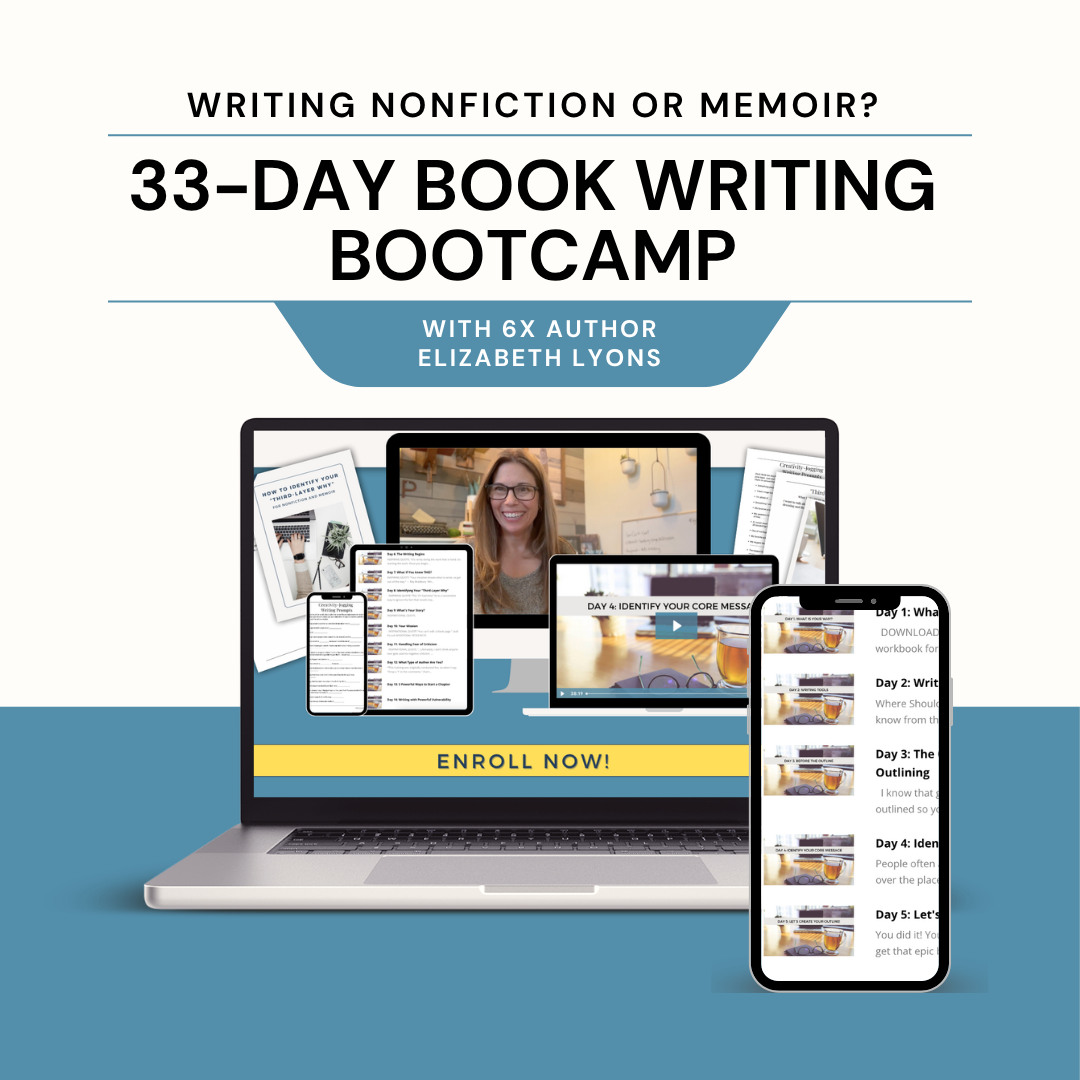
Ready to Write the Damn Book Already?
Get the first draft of your nonfiction or memoir written in 33 days!
...even if you don't have a cabin in the wilderness, 4 uninterrupted hours a day to write, or confidence that you're a "real" writer.

Amazon Ads for Indie Authors!
Learn how to run Amazon ads that actually work—even if you’ve never touched an ad platform in your life.

Want all my best author email templates?
From communicating with your launch team to building long-term relationships with readers, these templates take all the guesswork out of writing emails that turn email subscribers into loyal readers!

Need Coaching, Accountability & Community?
The Book Writers Collective provides the coaching, support, and writers' community you need to bring your book to life!

SELF-PUBLISHING STARTER KIT
Discover the exact steps to focus on (and mistakes to avoid) so you can self-publish an incredible book that's indistinguishable in quality from a New York Times bestseller.
