
Ep 181: Joyce Maynard on Storytelling, Permission, and Who Gets to Tell the Truth
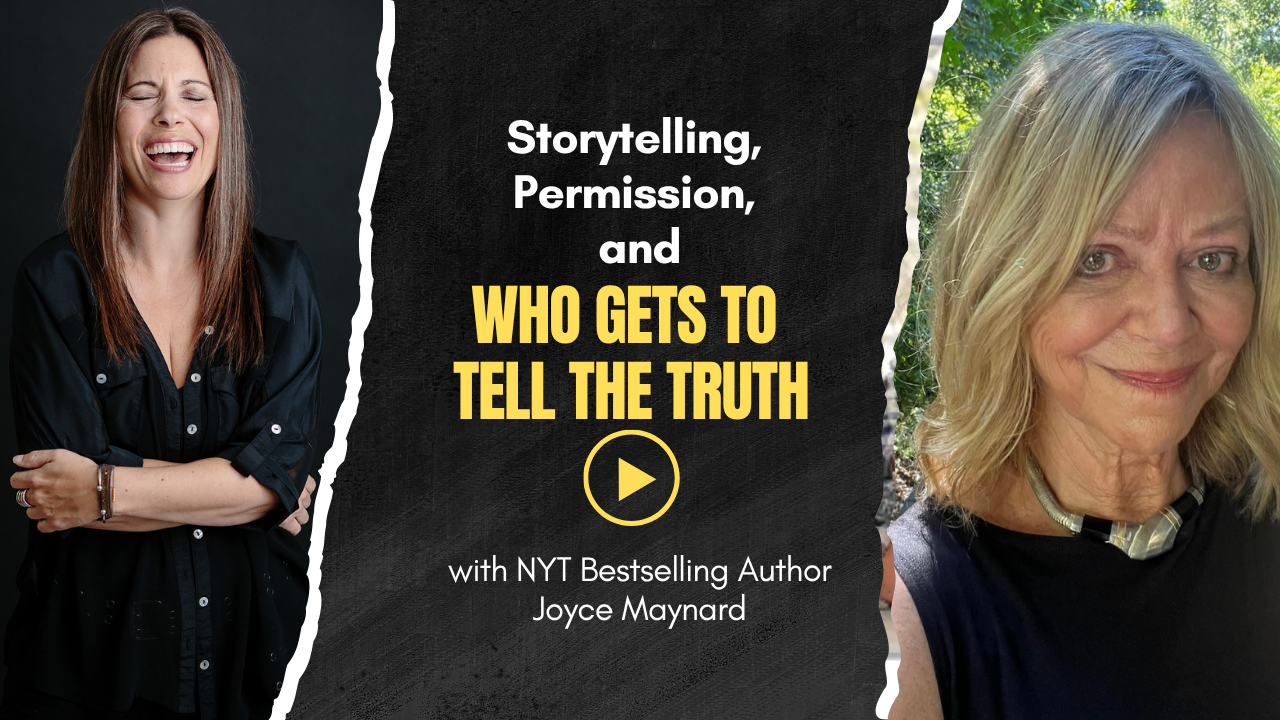
If you are trying to figure out how to write a memoir and you keep stalling out on one specific worry, that being what your mother is going to say, you are in extremely good company. Joyce Maynard has hosted memoir retreats for more than 25 years and well over a thousand women, and she says the same question comes up every single time.
Men do not ask it. Women ask it constantly.
How do I tell an honest story about my life without hurting the people in it?
I got to sit down with Joyce for the Write the Damn Book Already podcast a few days after her fourteenth novel, In Wonderland, came out. I had one goal going in, which was to not ask her a single question she has already answered a thousand times. We were in Guatemala by minute four, so I think it worked.
Here is what came out of it, and why it matters if you are a first-time author sitting on a story you are not sure you have permission to tell.
Who is Joyce Maynard?
Short version for anyone who is new to her work. Joyce Maynard has been publishing books for 53 years. She has written 14 novels, including Labor Day, The Usual Rules, and The Bird Hotel, plus memoirs including At Home in the World and The Best of Us. She is 72. She still writes every day, she still swims in lakes, and her energy at 10 a.m. Eastern made me want to lie down.
She also owns a piece of land on the shores of Lake Atitlán in Guatemala that she bought at 44 after swimming past a for-sale sign. It is now a retreat center where she runs memoir workshops for women. This is a person who has never once waited for permission, which is exactly why her answer to the permission question carries weight.
What happens when you tell a story other people wanted kept quiet
In 1998 Joyce published At Home in the World, the memoir about her relationship at 18 with J.D. Salinger, a man who sought her out on the basis of her writing. The literary world, with a handful of exceptions, decided that the person who had done something wrong was her. She was described in reviews as the predator. For writing about her own life.
It took her 25 years to write that book. Not because she needed 25 years to understand what happened, though that was part of it. She waited because she had been told not to tell it, and she obeyed. She had absorbed the idea that this important, spiritually elevated man deserved her silence.
She said something in our conversation that I have not been able to shake. The reason she works so hard with women on telling their stories, whether or not those stories ever get published, is that she knows exactly what it feels like to be told you have no right.
And she does not think publication is the bar. If you write the thing and it lives in a drawer, that counts.
Joyce Maynard's answer to the permission question
Her position is not complicated, and it is not reckless either. She is genuinely protective of certain people's stories. Children's stories are their own category, and she is careful there. All the stories she tells, she pointed out, are not the same as all the stories she does not tell.
But her floor is this: we do not live in a vacuum on this planet. We bump into each other. We love each other, we hurt each other, we get changed by each other. Which means the story of your life is unavoidably going to include other people, because that is what a life is made of.
Every woman deserves the right to tell the story that she has lived.
If you are stuck on memoir writing because of who is in it, I would sit with that one for a while.
Should you write a memoir as therapy?
This is where Joyce and I got into the good stuff, because I work with a lot of memoir writers and I see this happen constantly.
Joyce does not regard her books as her catharsis. She thinks it matters that a writer has worked through something before she writes about it. Not gotten over it. Worked through it enough to stand on solid ground while she is doing the work of telling it.
Her line: there is no timetable for processing your story, but it does need to be processed.
That does not mean you should not write while you are in the thick of it. She started writing The Best of Us, the memoir about finding and then losing her second husband Jim to pancreatic cancer, the night he died. For her that was the most natural thing in the world to do.
What she means is that at some point, the tools and disciplines of good storytelling have to get applied to the material. Feeling your pain on the page is one job. Building something a reader can walk into is a different job. A lot of what you write first is never going to see print, and that is not wasted work. That is the part that gets you to solid ground.
How Joyce Maynard writes a novel without an outline
For the book writing nerds among us, this part was fascinating.
Joyce does not outline. She mentioned doing an event the night before with Jodi Picoult, whose outlines are so thorough that half the work is finished before the writing starts. Joyce called her a wonderful writer and then said, cheerfully, that this is not her at all.
What she does instead is know her characters completely before she starts. Their obsessions. Their fears. Their deepest vulnerabilities. What they want and what they yearn for, which are frequently not the same thing. Then she lets the story come out of who those people are.
Her words: story should come out of character, not the other way around where you build a plot and plug some people into it.
If you have ever felt like a failure because you are not a plotter, please note that a woman with 14 novels does not know what her characters are going to do until they do it.
What to do when you feel stuck writing a book
I asked if she ever gets stuck. She would not accept the word.
What she gets instead is a moment of whoa, what is she going to do now, which she described as curiosity rather than a wall. Then she goes and swims a long way in a lake and thinks about it. She is still moving through it the entire time.
She also does not wake up with nothing in her head. Her problem is the opposite one, which is too much coming in at once and the challenge of narrowing the focus.
That has a backstory. Joyce went back to Yale at 65, decades after dropping a full scholarship at 18. She took an intensive French class, studied hard, felt great about her exam, and got it back with a D- on it and a professor asking whether she had ever been tested for learning differences. Nobody in her generation was. The testing showed she reads in the 17th percentile nationally. She was handed a prescription she has never filled, because after all these years she has built her own ways of being herself, and because the flip side of what she has is enormous hyperfocus. She considers it the reason she writes the way she does. Short chapters. Clarity. Nothing in the way.
Write what you know, and also write what you don't
The best writing advice in the whole conversation came at the very end, almost as an aside.
Joyce writes the book she wants to read. She is her own first reader. She is not thinking about what is selling this year or which author she wants to sound like. And when she sits down, she pictures herself making a movie that will play in your head. She is the screenwriter and the director and the lighting person. She gives you a scene and she trusts you to figure it out, because publishing for this long has given her real respect for how smart readers are.
Then she said this. Everybody tells you to write what you know. But you should also write what you don't know, because that is where the discovery lives.
She proved it on herself in real time. She was describing The Usual Rules, the novel about an angry 13-year-old girl whose mother goes to work at the Twin Towers on September 11 and doesn't come home. Joyce wrote it in the months after 9/11, when her own daughter was well past 13 but they had fought bitterly at that age. She had thought the thing that parents think and never say out loud, which is if I died, she would be so sorry.
She stopped mid-sentence in our interview and said, hmm, there is a theme in my life. Then, that's what happens when you write. You just discover.
CONNECT WITH JOYCE MAYNARD
Website: joycemaynard.com
Instagram: @therealjoycemaynard
Retreats in Lake Atitlan, Guatemala
Want to Stay in the Know?
Sign up to receive the latest book industry news and updates!
Ready to Write the Damn Book Already?
Get the first draft of your nonfiction or memoir written in 33 days!
...even if you don't have a cabin in the wilderness, 4 uninterrupted hours a day to write, or confidence that you're a "real" writer.

Amazon Ads for Indie Authors!
Learn how to run Amazon ads that actually work—even if you’ve never touched an ad platform in your life.

Want all my best author email templates?
From communicating with your launch team to building long-term relationships with readers, these templates take all the guesswork out of writing emails that turn email subscribers into loyal readers!

Need Coaching, Accountability & Community?
The Book Writers Collective provides the coaching, support, and writers' community you need to bring your book to life!

SELF-PUBLISHING STARTER KIT
Discover the exact steps to focus on (and mistakes to avoid) so you can self-publish an incredible book that's indistinguishable in quality from a New York Times bestseller.
Recent Posts
